

Mainsail
mainsail all-purpose
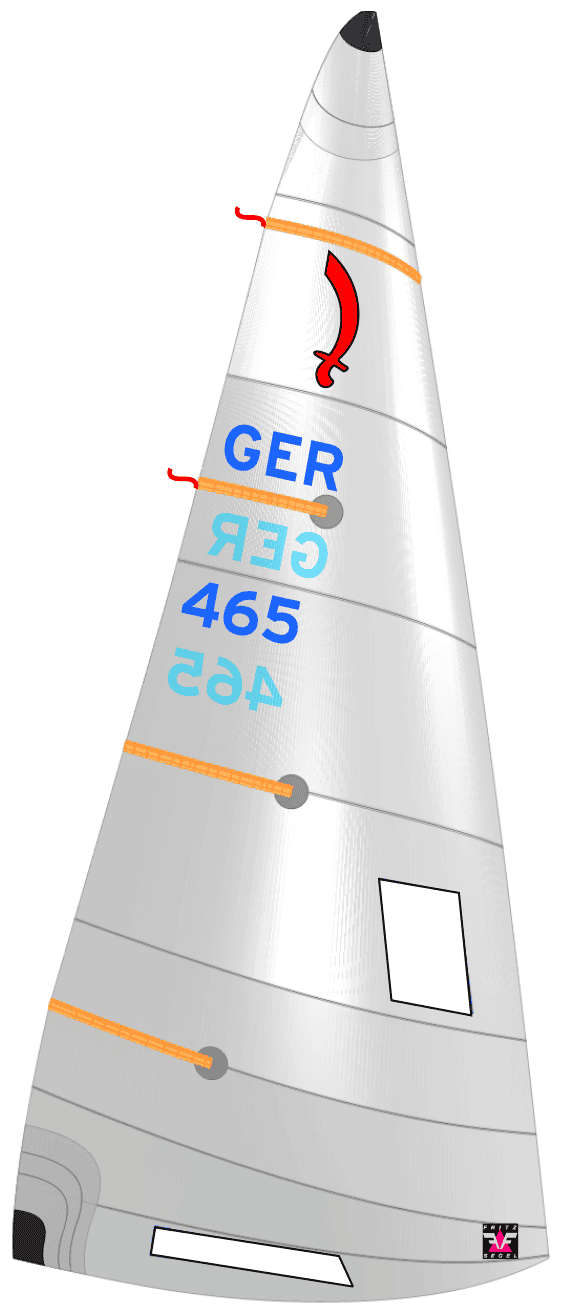
Our mainsail has a deliberately wide head area — and for good reason. Due to the minimal offset of the sheave at the masthead, the sail head is pulled strongly toward the center solely by halyard tension. This significantly reduces twist in the upper section in light winds.
Thanks to the broader head, the headboard is able to twist more effectively even in low pressure and on downwind courses, ensuring a more balanced and efficient sail shape in the top section.
The open foot allows the mainsail to respond directly to foot tension. With the outhaul eased, the sailcloth immediately falls into the desired profile.
The luff curve provides a wide range of trimming possibilities. The boom vang, in combination with the mast controller, are the key tools for this.
Our mainsail is built from 180 g hard‑finished cloth in the body. For the head section, we use a heavier 200 g hard‑finished cloth to achieve the required strength for the enlarged head area.
The short, tapered battens are bonded into their batten pockets, ensuring they lie perfectly against the sail on either tack.
The tension of the top batten can be adjusted via a Velcro system.
Conclusion
This mainsail is the optimal, easily adjustable sail for all wind and wave conditions.
Headsails
Genua all-purpose
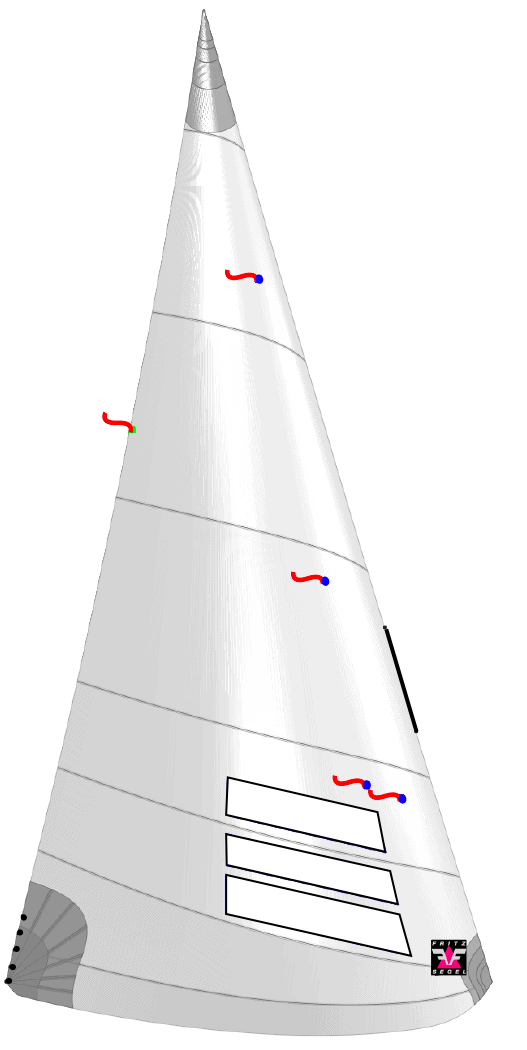
The genoa is made from 3.8 oz cloth. This hard‑finished material is characterized by excellent shape stability.
The profile of the all‑round genoa is highly powerful thanks to its depth and the full upper section. The slightly rounder exit in the top area allows lighter crews to induce strong twist without creating instability in the leech. As a result, the mast can be raked significantly further aft before the genoa sheet needs to be re‑tied.
The rounded entry provides a very comfortable steering groove, allowing the boat to be guided smoothly through waves. The boat accelerates very quickly after a tack.
If you need to pinch a bit at the start or when approaching the windward mark, a moderate increase in rig tension is enough to noticeably flatten the entry.
The clew is equipped with four cringles, allowing you to achieve any desired mast rake.
Conclusion
Fast, easy‑to‑handle sail that performs in all wind and wave conditions.
Genoa Light
The cut of the Genoa Light is identical to that of the all‑round genoa. The sail develops an effective profile even in the slightest breath of wind, thanks to the exceptionally light 130 g square‑weave cloth we use. This fabric reacts far more sensitively to pressure changes, making it effortless to steer right on the wind edge, even in questionable conditions.
Due to the low cloth weight, the genoa practically flies onto the new tack by itself in light‑wind tacks.
However, the increased cloth stretch requires more frequent adjustments to sheet tension. The effective operating range of the Genoa Light extends up to 2 Bft.
Conclusion
In tricky light‑wind conditions, this sail is the right choice.
Spinnaker
Spinnaker PS 1
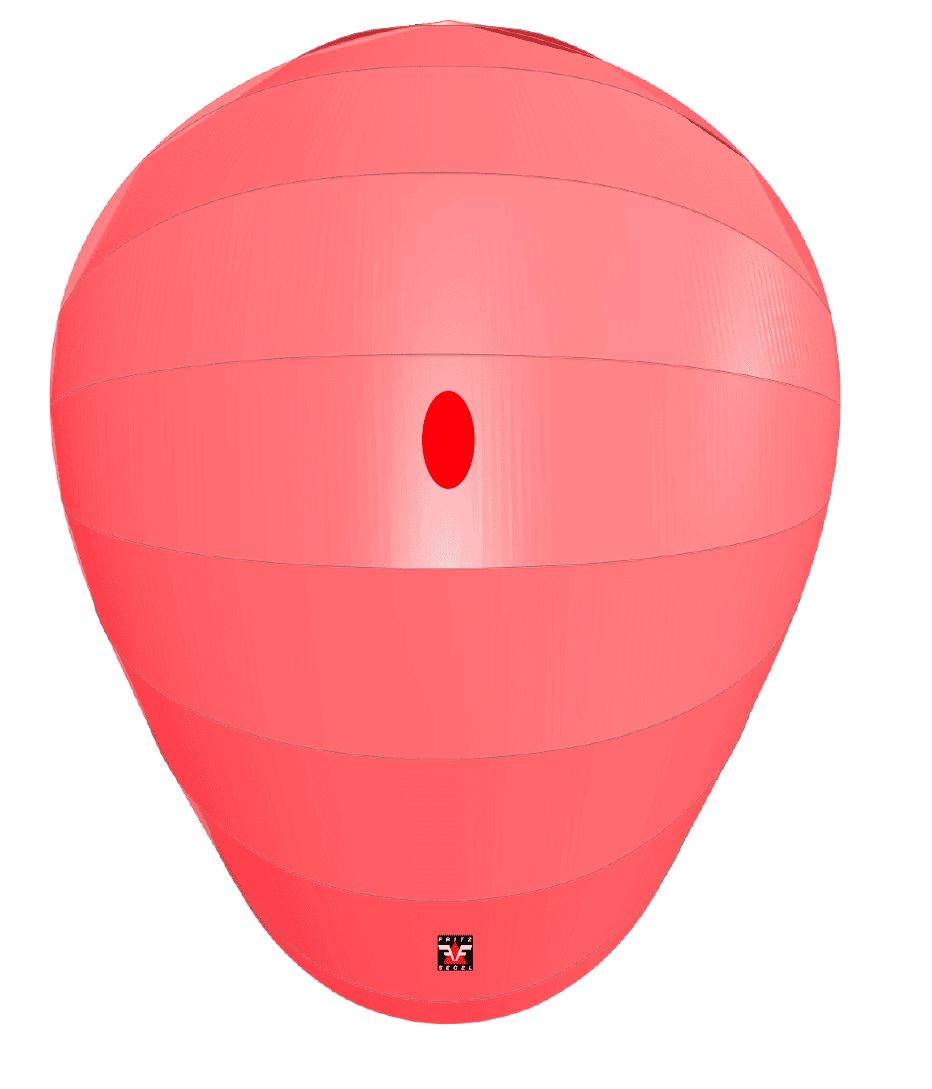
Our Corsair spinnaker is built in a crosscut layout. For this sail, we use a 0.75 oz Dynakote cloth featuring an extremely low‑friction coating.
The resistance during hoisting and dousing is reduced to an absolute minimum, and thanks to the smooth surface, moisture can be easily shaken out of the cloth.
Due to the consistently horizontal panel layout, the side leeches run—especially in the shoulder area—diagonally across both warp and fill of the material. As a result, the leeches in the upper part of the spinnaker stretch under load. The upper half of the sail flattens noticeably, the shoulders become significantly broader, and the projected area increases.
On tight reaching angles, the entry can be significantly flattened by slightly topping up the spinnaker pole.
Conclusion
The PS1 gives you the decisive meters on downwind and reaching courses on your way to the finish.
Spinnaker PS 1 light
The design corresponds to the PS1. Thanks to the significantly lighter cloth, the spinnaker delivers outstanding light‑wind performance. Even with the slightest ripple on the water, the shoulders open. The leeward leech rises very early, opening the slot between spinnaker and mainsail.
To keep the spinnaker standing, you need far less luffing, which shortens the distance sailed to leeward considerably.
Because of the lighter cloth, the sail’s packed volume is noticeably smaller, making hoisting and dousing effortless.
Conclusion
We particularly recommend this new spinnaker for light‑wind venues up to 20 kn of wind.