

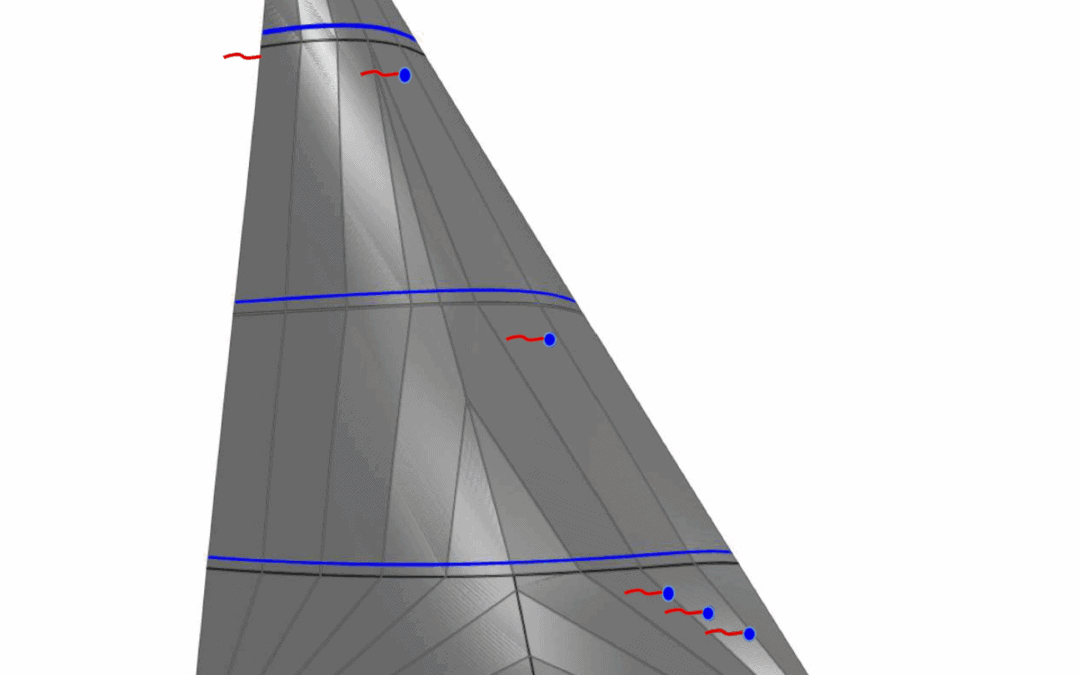
A newly developed asymmetric sail designed for tight reaching angles—called the “Code Zero”—was first used in the Whitbread Round the World Race. Since then, the Code Zero has become an established part of the modern sail inventory due to its wide range of applications. It is not only used on boats that spend much of their time sailing close reaches in light winds; the Code Zero is also effective in stronger winds and at different wind angles.
The Code Zero fills the gap between a genoa and the universal asymmetric gennaker. In winds under 10 knots, it provides significantly more power on courses with 60°–70° apparent wind angle (AWA), where boats with conventional sails tend to be slow. Code Zeros have also proven effective on reaching courses in 15–25 knots of wind at apparent wind angles of 80°–90°. Overall, this sail type is particularly well suited for offshore conditions.
Code Zeros are more similar to a genoa than to a typical gennaker. For racing yachts, the Code Zero is still classified as a spinnaker, but its dimensions come as close as possible to those of a genoa. Its profile is flatter than that of other asymmetric sails, yet it still flies without the leech fluttering. The Code Zero has more vertical curvature than a genoa and a significantly higher amount of twist. The luff is cut straight, and the leech has a slight positive roach.
The design of a Code Zero may be influenced by measurement rules, yardstick ratings, or class regulations. Typically, this means:
- The leech must be less than 95% of the luff length.
- The mid‑girth must be at least 75% of the foot length.
- Additionally, asymmetric sails are subject to width restrictions or an area limit calculated using a formula based on luff, leech, foot, and mid‑girth.
The luff of a Code Zero should be as long as the rig allows. The tack point on the boat is located forward of the forestay. When setting the Code Zero on a retractable bowsprit, extreme caution is required. The sail generates a strong upward force to keep the luff as straight as possible. If the sail is used with a furling system (which is recommended), the distance between the furling drum and the forestay must be considered.
The Code Zero is hoisted and doused while rolled. When setting the sail, the luff line should be tensioned more than one might expect. Secure it as short as possible, as it is easier to ease later than to tighten. The sail should be hoisted with minimal cloth tension along the luff.
Some rigging specialists recommend using a 2:1 halyard to reduce load during hoisting and in the clutch. In any case, the halyard should have minimal stretch and be very strong. The sheeting point is usually the spinnaker block, but a barber hauler may be required. Leech line tension is very sensitive and can vary widely. Tightening it to stop flutter will create visible wrinkles along the leech—an unavoidable result of the positive roach required to meet the minimum mid‑girth measurement.
Furling the sail is quite simple: roll it up, ease the halyard, and stow the rolled sail in the forward hatch.