

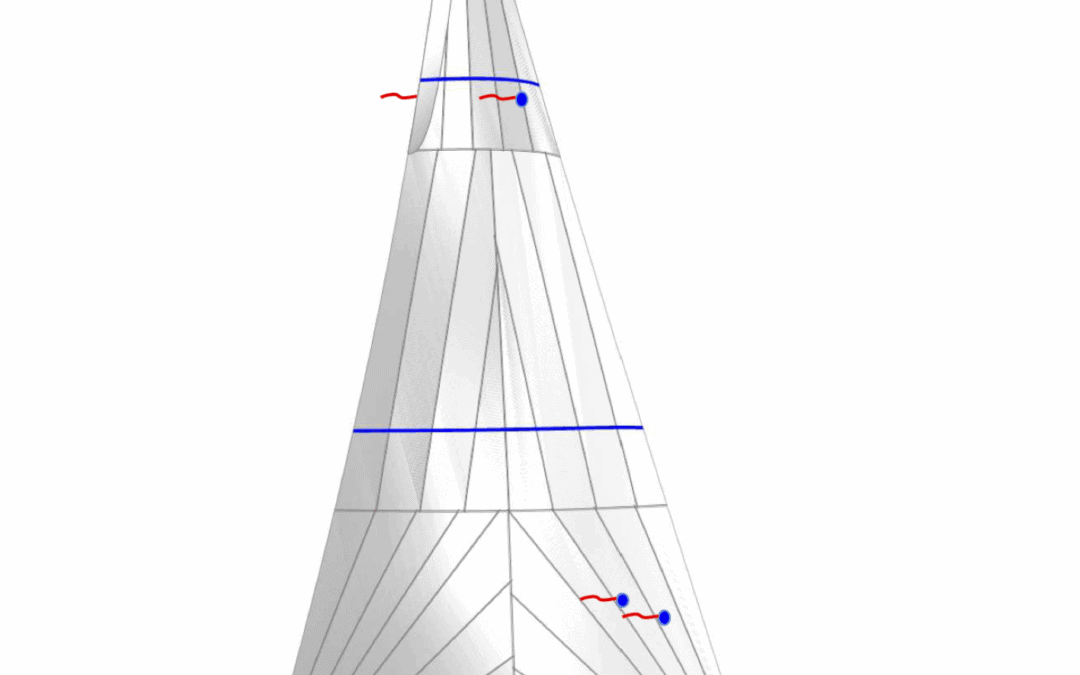
Furling genoas are easy to trim and add an important safety factor to any boat. FRITZ‑SEGEL has long been involved in producing furling genoas of all sizes, designs, and areas of application. These sails must hold up under all circumstances and always be ready for reefing. They are “all‑rounders,” but for that very reason they cannot excel perfectly in any one discipline. In light winds, one expects an excellent sail shape, while in heavy weather around Force 7 the genoa should still remain stable — an impossible task. You can read more about this in our detailed text on furling genoas.
Reinforcements and Luff Doubling
Furling genoas are always built with additional leech and foot reinforcements, as well as a reefing luff made of rope or foam. In light‑wind sailing areas, it is advisable to omit such luff padding in favor of better sail performance and more speed. Reefing the genoa is still possible, but the entry shape when reefed is slightly inferior compared to a sail with padding.
UV Protection
A UV strip on the leech and foot is recommended, especially for yachts sailing in southern latitudes and spending many hours at anchor during the day. It protects the genoa from harmful UV radiation. However, UV protection alone is not sufficient to safeguard your headsail during longer periods in the harbor. For this — and on inland waters — we recommend always having a dedicated headsail cover with tie‑down straps, or removing the sail entirely.
Some manufacturers of furling systems, as well as certain sailmakers, like to suggest that purchasing a furling system together with a furling genoa fully equips your yacht. This is only partially true. On lakes in Upper Bavaria, a 150% furling genoa may be sufficient for the season, but a storm jib — which can be hoisted in case of a sudden thunderstorm — should never be missing.
Things become more complicated offshore. A furling genoa can only be reefed by about 30% of its size if it is still expected to perform well. If reefed to around 50% of its total area, the rolled luff becomes very thick, the sail becomes too full, and the sheeting point moves far forward, making precise adjustment on the track nearly impossible. For this reason, a Genoa III is practically unavoidable if you want to sail safely and efficiently in strong winds. A storm jib is essential on board in any case.