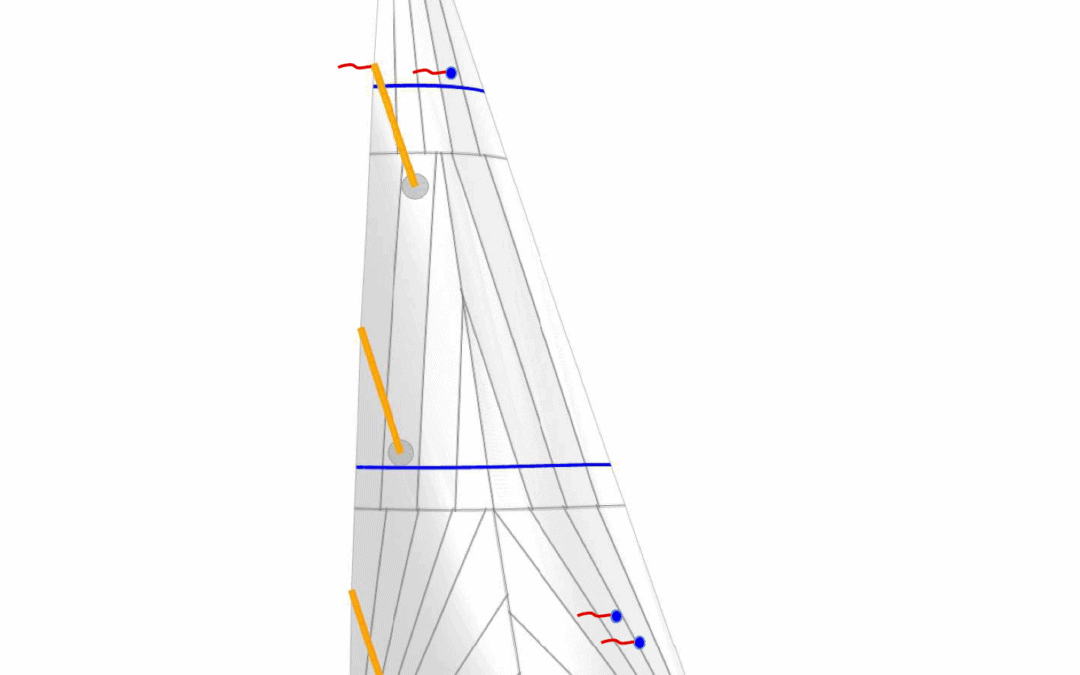

At first glance, the Genoa III and the jib look very similar. Both sails are characterized by a short foot that reaches only to the mast (about 100%–110% LP), as well as a long luff and leech. However, on closer inspection, you will notice that the Genoa III is made from significantly stiffer and heavier cloth than the jib. The Genoa III is used when the Genoa I and Genoa II cause your yacht to heel too much and generate excessive turbulence over the mainsail. It is designed for winds above 20 knots and has a noticeably flatter profile than the larger headsails. Corresponding to the higher wind strength, the deepest point of the profile is positioned further forward. This gives the sail a rounder entry, helping you steer your yacht more easily along the wind edge in choppy conditions.
Jibs, on the other hand, are all‑purpose sails and are commonly used on modern yachts as well as on boats equipped with a self‑tacking track. On many modern yacht designs, it is no longer possible to use large, heavily overlapping genoas. Long, strongly swept‑back spreaders and shrouds mounted far outboard make this impossible. As a result, slim, tall, and highly efficient jibs with minimal overlap are increasingly used. They can be sheeted further inboard and allow for a smaller angle of attack, enabling your yacht to point higher into the wind.
The profile of a jib has nothing in common with the flat profile of a Genoa III. Instead, it resembles that of an all‑purpose genoa. To maximize sail area, the leech of the jib can be cut straight or even with a positive roach. Battens in the leech ensure a clean shape. Arranged parallel to the luff, they allow the jib to be furled around the forestay.
Genoa 3 and Jib